Experience fast multiplier rounds, instant cashouts, and official certified fair play.
Cricket is one of the most famous sports and has different formats such as Test cricket, One Day Internationals, and Twenty20. In order to understand a cricket match, you should understand how runs are scored, what impact the wickets make on the game, and how the scoreboard looks. Knowledge of the cricket scoring system will allow newcomers to follow each delivery of the ball and enjoy the match.
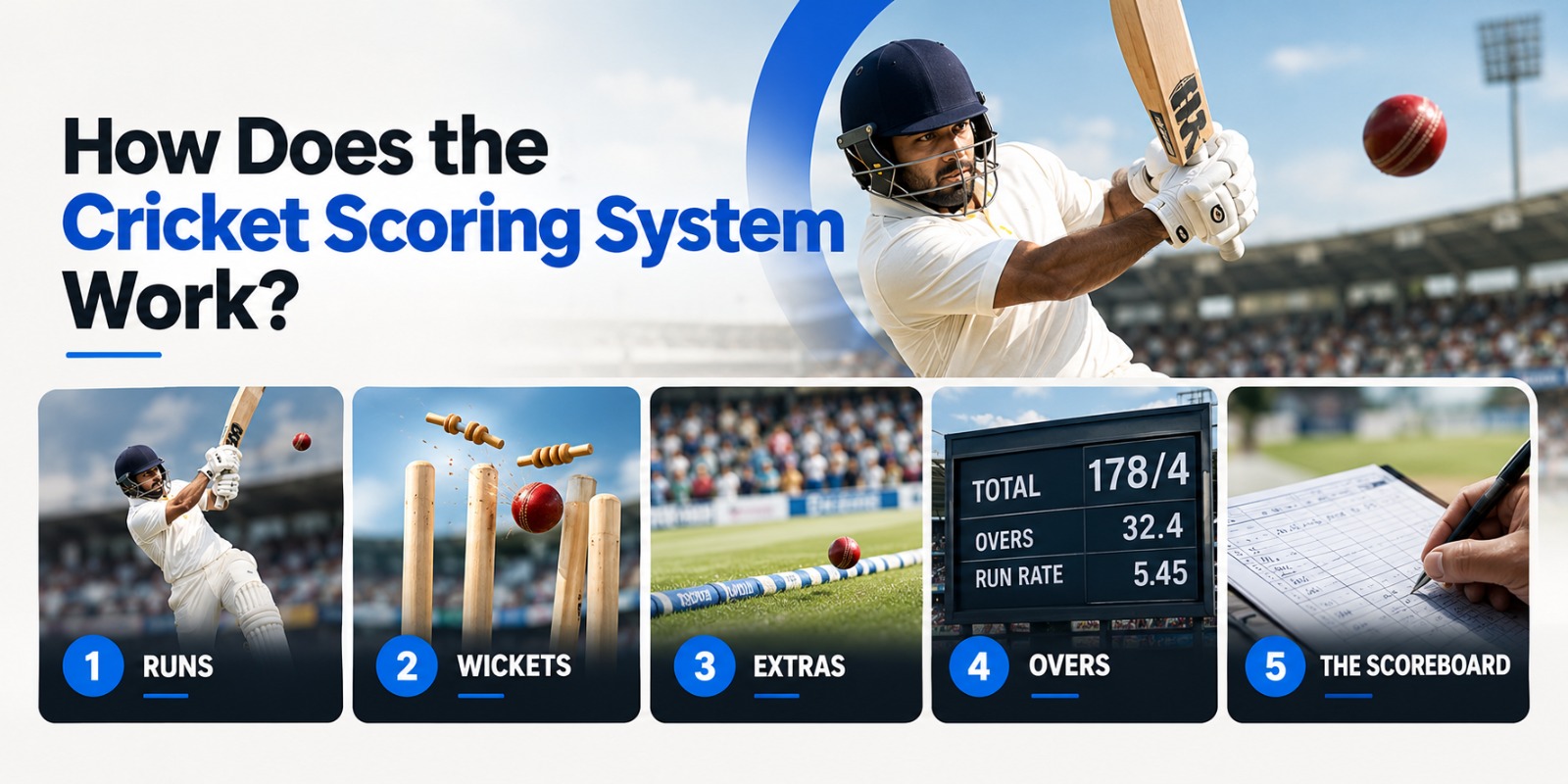
In this article, we will discuss cricket scoring system rules, runs, wickets, overs, extras, run rate, and how the teams win the matches.
The cricket scoring system keeps track of the runs scored and wickets lost by a team in an innings. Overs, performance of individual batters, and many other match statistics are also recorded.
For instance, if the scoreboard shows 156/4, it means that the team has scored 156 runs and has lost four wickets.
Usually, a cricket scoreboard consists of the following information:
Runs – the total number of runs scored by the team;
Wickets – the number of batters who were dismissed;
Overs – the number of overs bowled.
Batter's Runs : The runs scored by each batter.
Bowler's Figures : The number of overs bowled, runs given away, and wickets taken.
Extras : Runs earned from wides, no balls, byes, and leg byes.
This information assists viewers in understanding how the current match is going.
Runs are used to measure the performance of the team. Runs can be earned in several different ways during a cricket game.
Running Between the Wickets
Batters can take runs by running between the two sets of wickets after hitting the ball. Running completes one run for the team.
For instance, three completed runs mean the team gets three runs.
Boundary Four
The batting team usually scores four runs when the ball touches the ground within the cricket field and then goes out of the field boundary.
Boundary Six
A six-run is scored when the batter hits the ball to go out of the field boundary without touching the ground in the playing area.
Extras
The extras are runs scored by the batting side which do not come under the runs of any individual batter. There are mainly:
Wide : Delivery which is outside the reach of the batter as a fair ball as per the applicable rules. Usually results in one extra run scored and more runs can be scored.
No-ball : Illegal delivery like some front-foot or dangerous deliveries. Usually results in one extra run and the batter can also score other runs.
Bye : Runs made without the ball hitting the bat or the body of the batter, and the batters run for them.
Leg bye : Runs made by the ball hitting the body of the batter as per the applicable rules.
Normally the deliveries of wide and no-balls do not count as valid balls in an over. The byes and leg byes can count as valid balls if the delivery is valid.
Generally, wickets refer to dismissals made against a batter. With each dismissal, the team loses a wicket.
Ten wickets are usually available in a cricket innings since there are eleven players in the batting side and one batter needs to be at the crease.
Some common dismissals made against a batter are:
Bowled : The ball strikes the stumps and knocks off the bails.
Caught : The fielder takes the ball off the bat before it hits the ground.
LBW : The batter is out LBW when all the requirements are satisfied as per the laws of cricket.
Run out : A batter is out of his/her ground when the wicket at his/her end is broken fairly while he/she is taking part in certain acts of running.
Stumped : The wicket keeper breaks the wicket fairly while the batter is out of his/her ground and not in the process of making a run, under certain circumstances.
The scoreboard reading 85/3 would mean that the batting team has made 85 runs and lost three wickets.
All dismissals may not be attributed to the bowler. For instance, a run out would not usually result in a wicket being put to the bowler's credit.
An over consists of six legal balls bowled from one end of the pitch. The bowler switches ends after every over, and another bowler bowls from the other end of the pitch.
However, wide deliveries and no-balls do not form part of the six valid balls and hence can be more than six deliveries in an over.
The amount of overs varies depending on the type of game being played:
Test cricket : Normally, 90 overs are scheduled for a day, according to the playing conditions. Games usually take place for five days.
One Day International (ODI): In this case, 50 overs are provided to each team.
Twenty20 (T20) : In this game, each team gets 20 overs.
The overs show how much time is provided to the teams to score runs.
Cricket scoreboards give important details about the games in a very compact manner.
In the following example, the details are given as:
Team A: 156/4 in 18 overs
In this case, the Team A has scored 156 runs, lost 4 wickets and 18 overs have been completed.
Some other information that is often found in a scoreboard includes the following:
Batter : Runs scored by a batter and number of balls faced.
Bowler : The number of overs bowled, runs conceded, and number of wickets taken.
Run Rate : Average runs scored per over.
Required Run Rate : Required rate of runs for the team batting second to achieve the target within the number of overs left.
Target : Number of runs that the chasing team needs to win the game.
With the knowledge of the above factors, one can easily determine the state of a game.
The run rate is an indication of the rate at which a team scores its runs in an over.
Formula for calculating the run rate:
Run Rate = Total Runs Scored ÷ Number of Overs Played
E.g. For a team that has scored 120 runs in 15 overs.
Run rate = 120 ÷ 15 = 8 runs per over.
In limited overs games, the run rate is used to show the rate of scoring. Net run rate can also be used in tournaments where the teams have equal number of points.
In the game of limited overs cricket, the team which bats first has set the target for the second team.
If the first team makes 180 runs, then the second team requires 181 runs to win the game.
For instance:
A Team scored 180/7 in 20 overs.
B Team will require 181 runs to win the game.
If B Team wins the game after scoring 181 runs without losing all its wickets or using up all its overs allowed, it wins the game under the match regulations.
If B Team has made 170/8, then it is a loss by 10 runs. The result is given in wickets, in case it achieves the target before losing all the wickets.
Though the basic scoring regulations for various formats are similar, the difference lies in the number of overs and the match format.
Cricket Formats Table
Format | Typical Overs | Match Structure |
|---|---|---|
Test Cricket | No fixed overs limit per innings | Up to five days, with up to two innings per team |
ODI Cricket | 50 overs per team | One innings per team |
T20 Cricket | 20 overs per team | One innings per team |
The results of test cricket include winning, losing, drawing, and tying. The other formats' matches usually end with either winning or tying the match.
The victory of a particular team in the game depends on the format of the match and the situation.
Runs : The team which bats first scores more runs than the other team.
Wickets : The chasing team reaches the set target before losing all of its available wickets.
Innings : In the test form of the game, the team wins by the innings if the opposition scores in their relevant innings fall below the score made by the team in its first innings.
Tie : The two teams end the match with the same score depending on the conditions of the particular match.
Draw or no result: Some matches end without a winner according to the format and conditions of play.
Conclusion
Knowledge about the process through which the scoring in the game of cricket takes place makes watching the game easy. Runs are what determines the score of a team, wickets indicate the number of dismissals while the overs tell the number of deliveries bowled.
With these fundamentals in place, one would be able to read the cricket scorecard, track the progress of the team and understand how the game is either won or lost.
Irrespective of whether you are watching T20, ODIs or Test matches, learning about the cricketing scorecard is an effective way to begin enjoying thea sport of cricket.
Content Creator & Gaming Analyst
I Sports Game Guide content team combines years of expertise in online gaming, sports analysis, and platform mechanics to bring you accurate guides, game reviews, and responsible gaming information.